

Introduction to Indonesian Charcoal Briquette Exports
Indonesia has long been recognized as a global powerhouse in the production and export of coconut shell charcoal briquettes. Revered for their high heat retention, minimal ash production, and eco-friendly manufacturing processes, these briquettes are highly sought after in the Middle East, Europe, and North America. However, penetrating these lucrative international markets requires strict adherence to stringent charcoal briquette export quality standards in Indonesia. Understanding these standards is critical for manufacturers, traders, and international buyers looking to ensure consistent product quality, safety, and regulatory compliance.
In this comprehensive guide, we will explore the essential quality parameters, certification requirements, laboratory testing protocols, and shipping logistics necessary for a successful export operation. Whether you are an established trader or a newcomer to the biomass energy sector, mastering these standards will safeguard your investments and elevate your brand’s reputation on the global stage.
Why Indonesian Coconut Shell Briquettes Stand Out
The global demand for Indonesian charcoal briquettes stems primarily from the raw material utilized: mature coconut shells. Unlike wood-based charcoal, coconut shell charcoal is entirely renewable and sustainable. The briquettes produced from this material boast a remarkably high fixed carbon content, which translates to a longer burning time and higher calorific value. Additionally, they produce zero smoke, zero sparks, and emit no foul odors, making them the premier choice for both shisha (hookah) lounges and premium barbecue applications.
To maintain this competitive edge, the Indonesian government and international trade bodies have established rigorous quality benchmarks. Failing to meet these standards can result in rejected shipments, financial losses, and damaged business relationships. Thus, quality control must be embedded at every stage of production, from the selection of raw coconut shells to the carbonization, crushing, mixing, molding, and drying processes.
Key Quality Parameters for Export
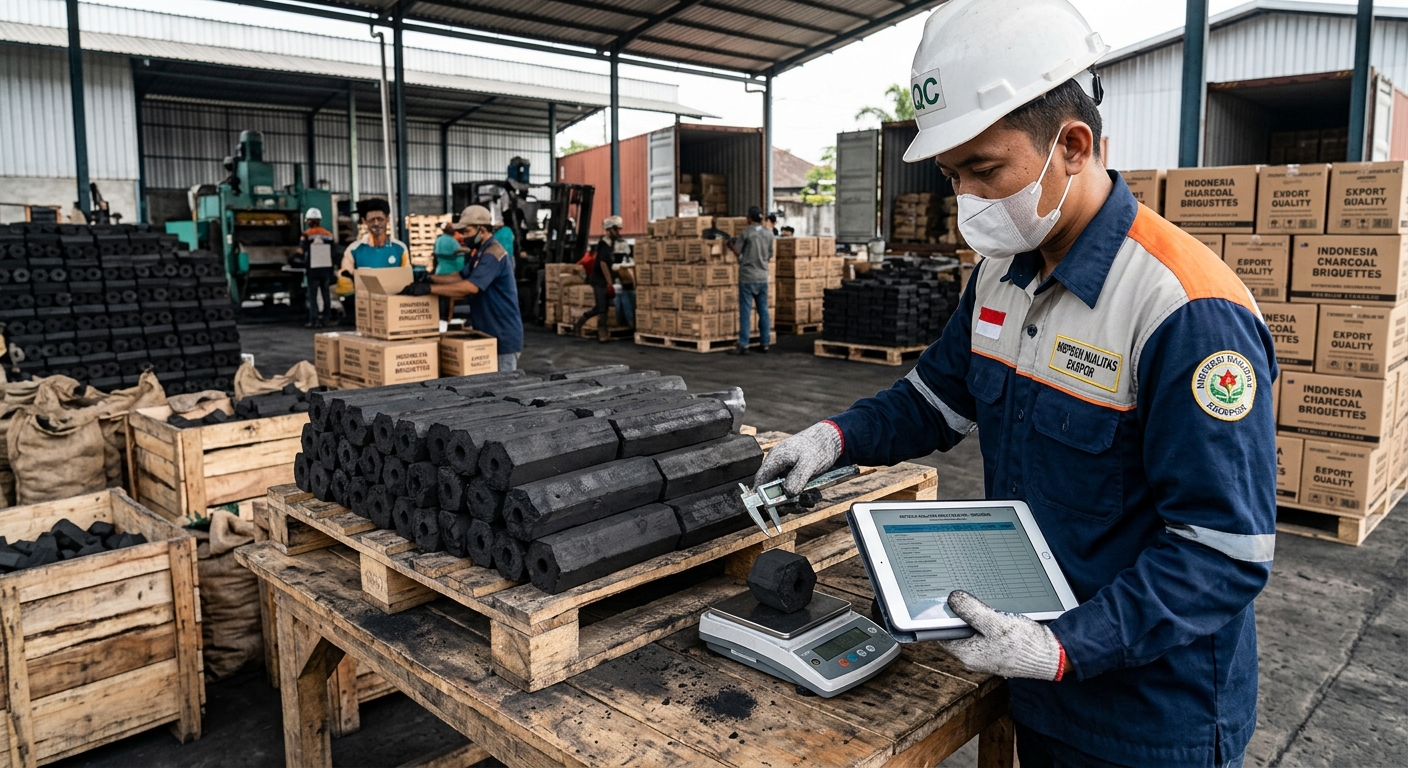
When discussing charcoal briquette export quality standards in Indonesia, several critical chemical and physical parameters dictate the grade of the product. These parameters are typically verified through independent laboratory testing before any shipment is cleared for export.
1. Moisture Content
Moisture content is one of the most vital metrics for charcoal briquettes. High moisture levels make the briquettes difficult to ignite, reduce their burning temperature, and can lead to mold growth during transit. For premium export-grade briquettes, the moisture content must be kept strictly below 5%. Advanced drying ovens and strict climate control within the manufacturing facility are required to achieve and maintain this low moisture level.
2. Ash Content and Color
Ash content directly impacts the burning experience, especially for shisha users who require clean heat without a powdery mess. High-quality Indonesian briquettes boast a maximum ash content of 2% to 2.5%. Furthermore, the color of the ash is a significant indicator of quality. Buyers typically prefer white or silver ash, as brownish or blackish ash indicates the presence of impurities or incomplete carbonization. Achieving white ash requires careful selection of clean coconut shells and meticulous filtering of the charcoal dust before briquetting.
3. Volatile Matter
Volatile matter refers to the remaining organic substances within the charcoal that evaporate as gases when heated. If the volatile matter is too high, the briquettes will produce excessive smoke and unpleasant odors during ignition. Standard export requirements dictate that volatile matter should not exceed 12% to 15%. A precise carbonization process is essential to burn off these volatile compounds while preserving the carbon structure.
4. Fixed Carbon
Fixed carbon is the combustible residue left after the volatile matter is burned off. It is the core component that generates heat. The higher the fixed carbon, the better the briquette. For premium export grades, fixed carbon levels should range between 75% and 85%. This ensures a steady, long-lasting burn time of up to 2.5 hours, which is a major selling point for Indonesian products.
5. Calorific Value
The calorific value measures the amount of heat energy released when the briquette is burned. It is typically expressed in kilocalories per kilogram (kcal/kg). Top-tier Indonesian charcoal briquettes must possess a minimum calorific value of 7,000 to 7,500 kcal/kg. This high energy output is crucial for both industrial smelting and recreational BBQ or shisha uses.
Physical Durability: The Drop Test
Beyond chemical composition, the physical integrity of the briquettes is paramount. Briquettes must endure the rigors of international shipping, including loading, unloading, and long-term storage, without crumbling into dust. Quality control includes a standard “Drop Test,” where a sample briquette is repeatedly dropped from a height of one meter onto a concrete floor. A premium briquette should withstand at least three to five drops without shattering. To achieve this durability, manufacturers use natural binders, primarily high-grade tapioca starch, at a ratio of about 3% to 4%.
Laboratory Testing and Certification
Compliance with charcoal briquette export quality standards in Indonesia requires independent validation. Buyers rarely accept a manufacturer’s internal quality claims without third-party laboratory reports. Renowned international inspection agencies such as SGS, Sucofindo, or Carsurin are typically employed to conduct these tests. A standard Certificate of Analysis (COA) will detail all the chemical parameters discussed above.
Furthermore, because charcoal is considered a potentially hazardous material (flammable solid) under the International Maritime Dangerous Goods (IMDG) Code, exporters must obtain a Self-Heating Test certificate. This test proves that the briquettes will not spontaneously combust during the sea voyage. Only after passing the Self-Heating Test (usually conforming to UN Class 4.2 exemptions) can the cargo be safely booked on commercial shipping lines.
Packaging and Logistics
Proper packaging is the final line of defense in maintaining briquette quality. Standard export packaging involves inner plastic liners to prevent moisture ingress, packed inside full-color printed inner boxes (typically 1kg, 2kg, or 3kg), which are then placed into sturdy master corrugated carton boxes. The master cartons are often strapped and wrapped in plastic shrink film on pallets to ensure stability inside the shipping container.
When exporting briquettes from East Java, understanding logistics is vital. Reading Incoterms for Shipping from Surabaya Port: A Complete Guide provides invaluable insights into shipping responsibilities, risk management, and cost allocation between buyers and sellers. Selecting the right Incoterm ensures that both parties are aligned on who handles insurance, freight costs, and customs clearance.
Diversifying the Export Portfolio
Many successful Indonesian exporters who master the strict requirements of the charcoal industry find it beneficial to expand their product offerings. The agricultural and biomass sectors in Indonesia are rich with opportunities. Finding a reliable export partner can streamline these compliance measures and open doors to cross-selling complementary products.
Similarly, agricultural byproducts are gaining traction, as seen in The Ultimate Guide to Finding an Organic Cocopeat Growing Media Exporter. Much like charcoal, cocopeat requires precise moisture and salt content management for international markets. While the focus is predominantly on agricultural and biomass products, some entrepreneurs diversify into wellness, leveraging resources like a Private Label Organic Cosmetics Manufacturer Indonesia: Your Complete Guide to expand their catalog and reach different consumer segments globally.
Conclusion
Navigating the charcoal briquette export quality standards in Indonesia is a rigorous but rewarding endeavor. By meticulously controlling moisture content, ash levels, volatile matter, and fixed carbon, manufacturers can produce world-class briquettes that command premium prices on the international market. Securing third-party laboratory testing, particularly the crucial Self-Heating Test, is non-negotiable for safe and legal shipping. As global demand for sustainable, high-performance biomass fuel continues to rise, Indonesian exporters who prioritize uncompromising quality and regulatory compliance will undoubtedly remain at the forefront of this booming industry.
Frequently Asked Questions (FAQ)
What is the ideal ash content for export-grade shisha briquettes?
For premium shisha briquettes, the ideal ash content should be between 1.5% and 2.5%. Additionally, the ash color should be white or silver, as this indicates complete carbonization and the absence of impurities.
Why is a Self-Heating Test required for exporting charcoal briquettes?
Charcoal has the potential to spontaneously combust under certain conditions. The Self-Heating Test is a mandatory safety requirement under international maritime regulations to prove that the briquettes are stable and will not catch fire during transit in a closed shipping container.
What is the standard binder used in Indonesian charcoal briquettes?
The standard and most preferred binder is natural, food-grade tapioca starch. It is typically mixed at a ratio of 3% to 4% of the total volume. It acts as a strong glue to hold the briquette together without adding any toxic chemicals or altering the smell of the smoke.
How important is fixed carbon in a charcoal briquette?
Fixed carbon is extremely important as it is the primary source of heat. Export-grade Indonesian charcoal briquettes usually have a fixed carbon content of 75% to 85%, ensuring a high calorific value and a long burning time of over two hours.